Why Your Triceps Routine May Be Holding You Back

Why Your Triceps Routine Might Be Holding You Back 

If you want strong, defined arms—or maximum pressing power—how you train your triceps matters. Many people overlook key anatomy and biomechanics, which means their technique isn’t as effective as it could be. Research shows you can build more strength in the overhead position than with the classic pushdown alone.

The triceps are the primary extensors of the elbow and upper arm, made up of three heads: medial, lateral, and long. For balanced development, all three need to be challenged. Take the common bent-over “kickback,” for example. It’s often performed without fully lengthening or contracting the muscle—especially the long head—limiting the motion of the triceps’ prime movers. Instead, include exercises that work the long head in both its most stretched and contracted positions for full benefit.

Overhead triceps movements also rely on the shoulder stabilizers to maintain proper elbow alignment. If shoulder health is an issue, variations with cables or bands can be a safer, but still effective, alternative.

Cable overhead with rope or bar
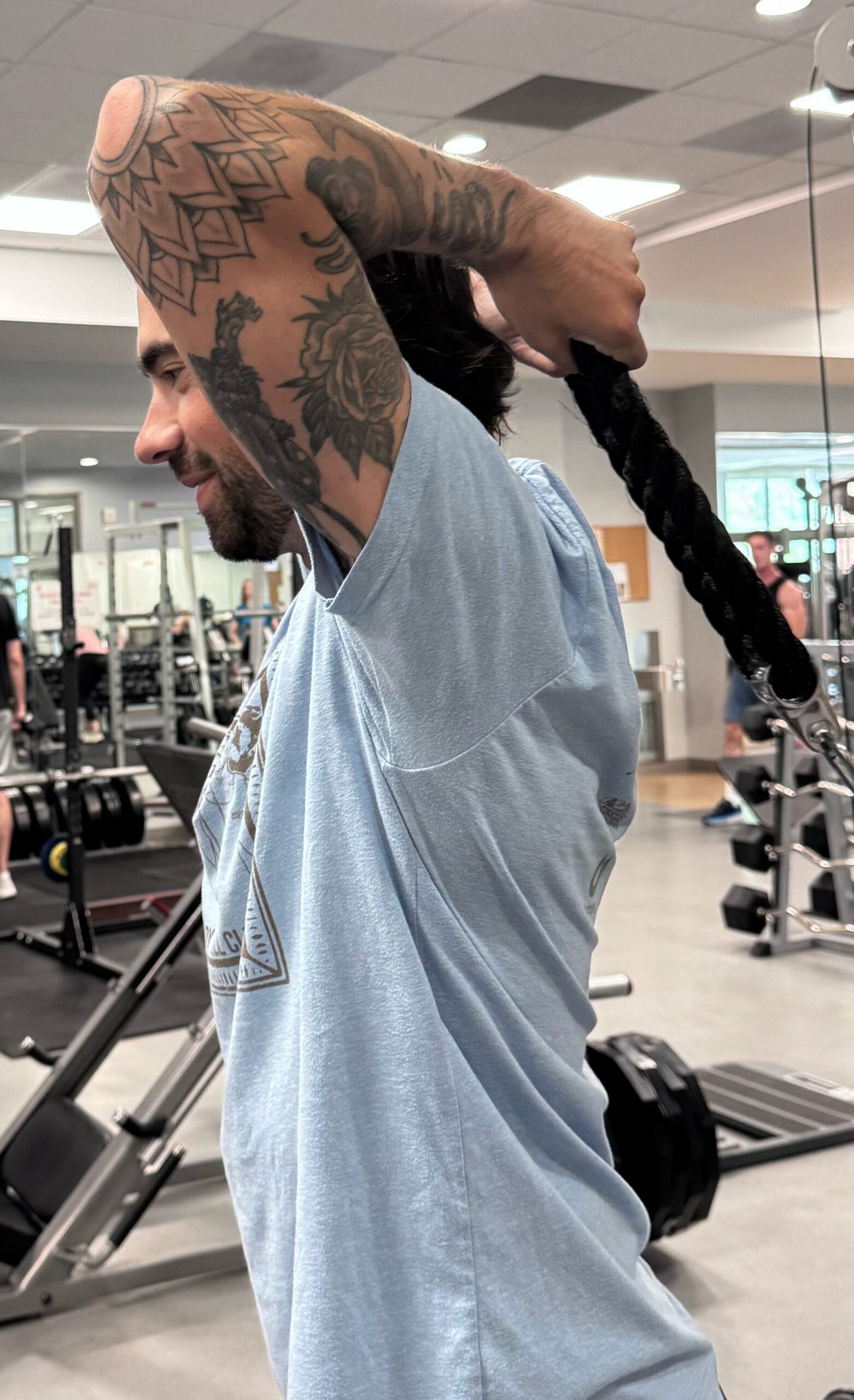
Overhead tricep extension with rope

The cable overhead using a rope or bar targets the long head of the triceps. This tricep exercise places the long head of the tricep on high tension, as the long head crosses both the elbow and shoulder joint.

  • Move the cable setting to waist level.
  • If using ropes, grab the rope underneath so that your hands are facing forward.
  • Stand in a staggered stance, and make sure you keep a neural spine throughout the movement: don’t overarch your back.
  • Keep elbows pointed straight ahead.
  • Start with elbows fully bent; it’ll feel like a big stretch.
  • Extend the arms as you extend your chest upwards. 
  • Fully lockout at the top of the move, and return to start. 

TRX Skull Crush
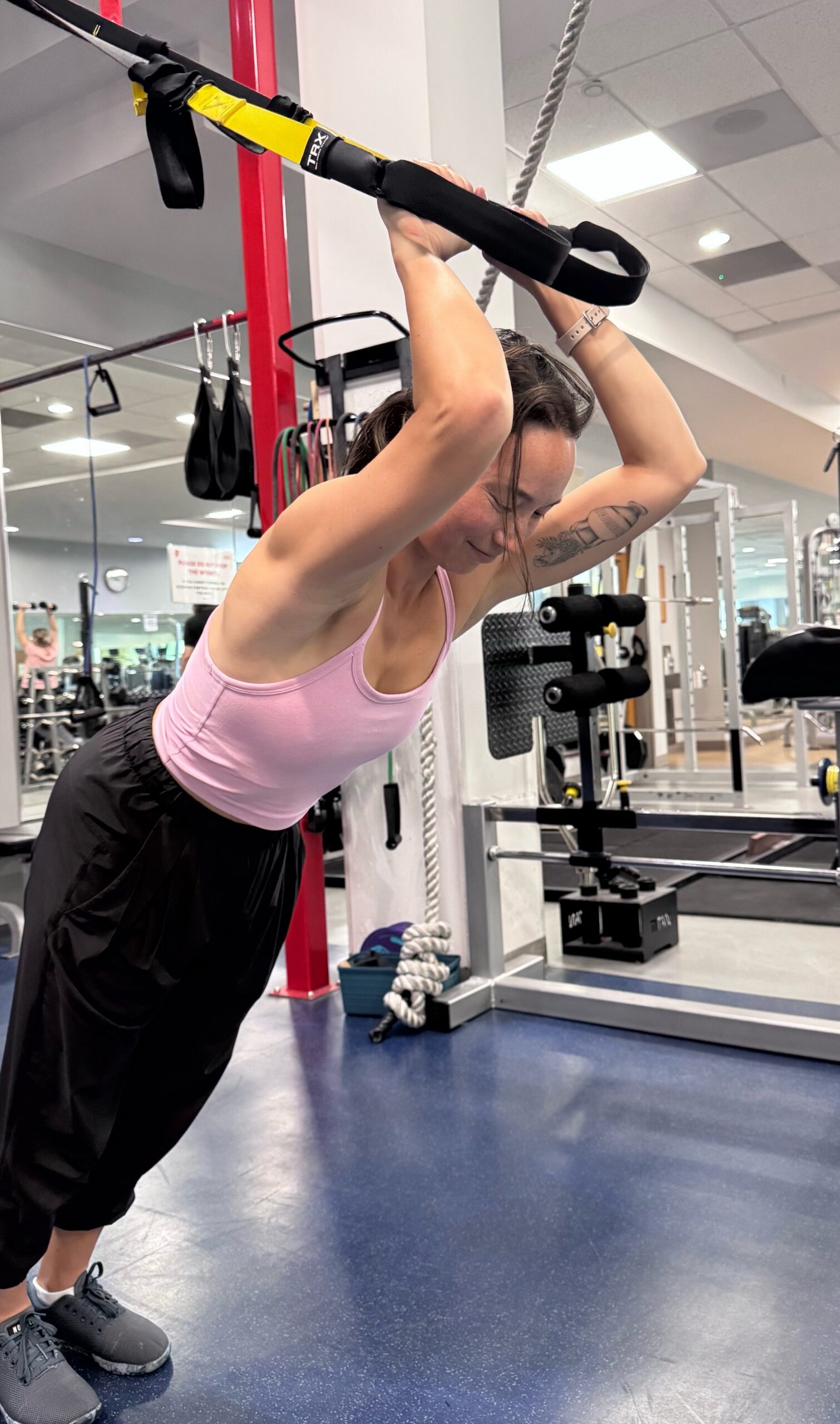
TRX skull crush

The TRX isolates and targets the triceps and includes isometric core stability. Using the TRX results in greater total body development than traditional barbell and dumbbell versions of this exercise. 

  • Set the TRX at mid-lenght.
  • Face away from the anchor, grab the handles, and lean forward so your torso is at least 45 degrees to the ground.
  • Position the arms in front of the chest, ( you will be in a plank position ) bend elbows to 90 degress. At this point, the hands should be at forehead height. 
  • Keep your trunk as stiff as a boad from head to heels,  and fully extend the arms.
  • 8-12 reps. 

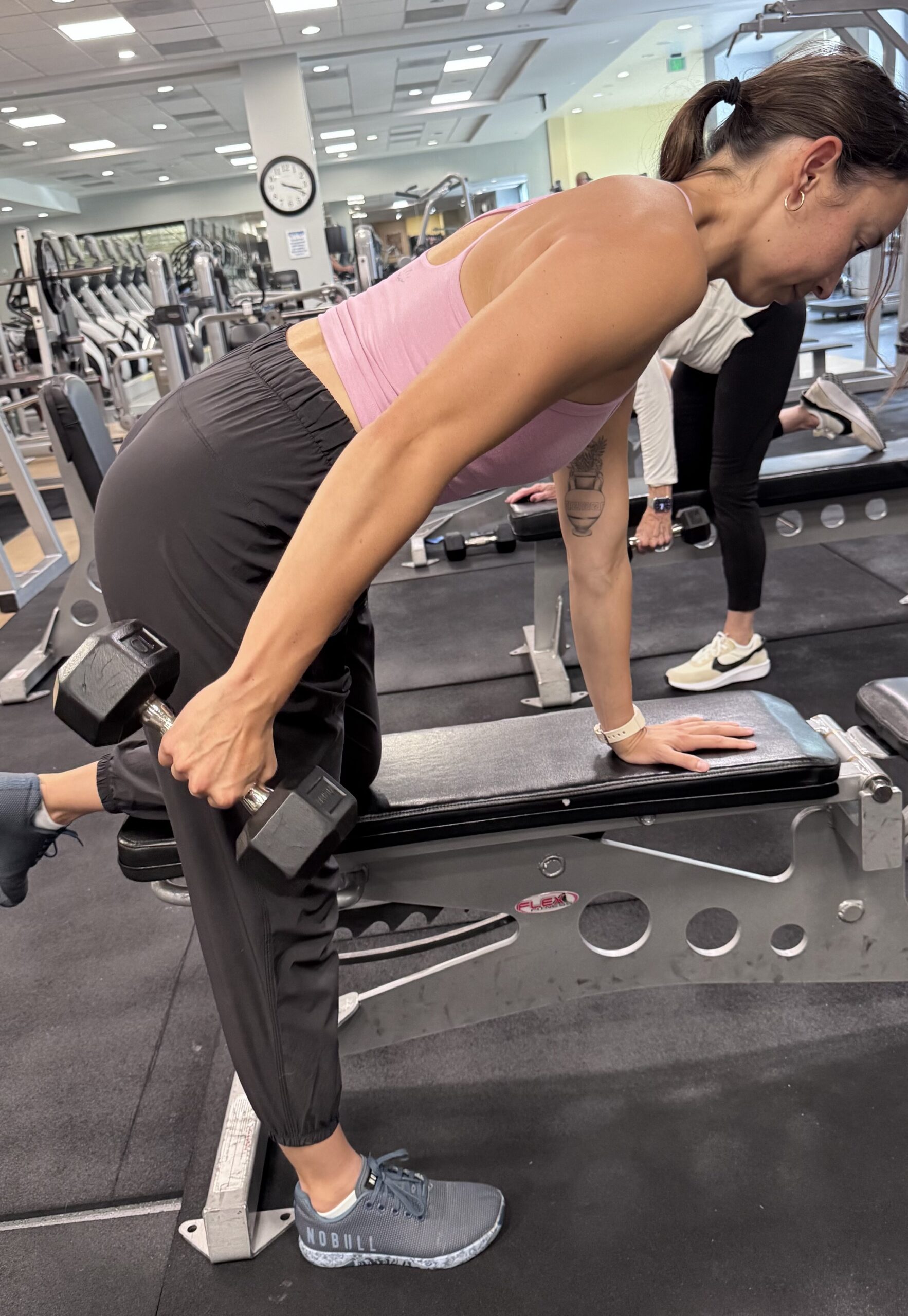
Tricep Kickback 

Tricep kickback

Tricep kickback

A common mistake, as seen in photo, is not holding the working arm high enough in order to create tension in the tricep, and not fully extending and shortening the arm.

Overhead triceps with a band
Overehead tricep extension with a band

Using a band is a great alternative if you don’t have a cable machine or are waiting for equipment at the gym. The band increases resistance as you extend your elbows, and you can adjust the tension by using different bands or changing the placement of your hand on the band. 

https://www.mtexpress.com/wood_river_journal/features/fitness-guru-why-your-triceps-routine-might-be-holding-you-back/article_268f1eab-a516-40b1-8c28-9eeaa16d8922.html

Can you stand on one leg? Amazingly, it can affect longevity

If your core is strong, you typically have good balance. Standing on one leg engages the core, and that ability is an indicator of overall well-being.

One-leg balancing involves using all 29 muscles of the core, called the lumbo-pelvic hip complex. But did you know that standing on one leg for 10 seconds can predict longevity? A recent study shows that the link between balance and longevity is an indicator of survival among middle-aged and older adults. Those that couldn’t do this simple task faced a higher mortality risk over seven years, emphasizing the critical role of balance for our health as we age.

Losing your balance as you get older is no joke. Research has shown that the ability to stand on one foot drastically decreases after the age of 60, along with a rapid increase of falls and injury. The ability to stand on one leg is imperative for gait and function.

Practicing the single-leg balance also improves your proprioception, or your body’s awareness of its position in space. Many daily movements involve being on one foot, even briefly, such as climbing stairs, putting pants on and stepping into a tub. Having better balance means daily activities that require coordination don’t have to result in falls or missteps.

You might think standing on one leg is a simple movement, but the ankles, lower leg, thighs, hips and core work together to make it happen. Try the following moves to test your skills!

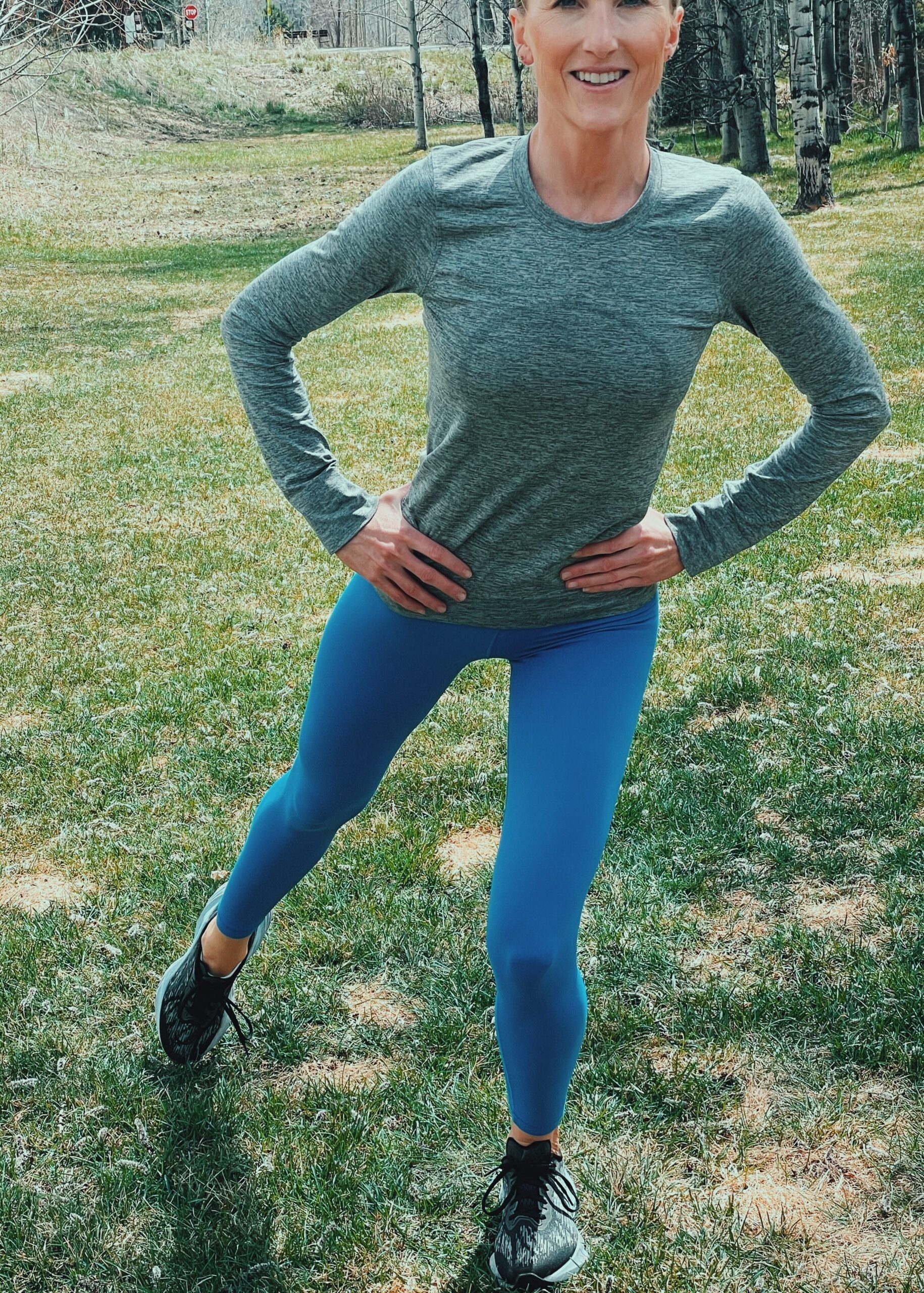
Single-leg balance

A woman is stretching on the floor with another person.
Single leg balance
Photo by Connie Aronson
  • Stand tall with your shoulders retracted. Feet are parallel and pointing forward. Hands are on the hips.
  • Brace the core, and flex the hips and knees slightly.
  • Lift one foot off the floor, keeping the toe of the raised foot pointed upward (dorsiflexed) and shift the center of your weight over the foot on the ground.
  • Maintain the slightly squat position for 10 seconds.
  • Return to the start; repeat on the opposite leg.
  • Tip: Keep the chin pushed back, with the head tilted neither forward or backward.

There are countless exercises to train balance. The following variation targets the gluteals and is a total body movement.

Single-leg balance and reach

A woman is stretching on the floor with another person.

Efficient movement requires appropriate levels of stability (standing on one leg), while simultaneously having appropriate levels of mobility (extending your leg outward). During this move you have to engage the stabilizers for good postural control as you move your leg. Because it is multiplanar (dynamic planes of motion), it correlates to movements in sports and daily activities.

  • Begin in a three-quarter squat, single-leg position as described for single-leg balance.
  • Maintaining balance, reach forward with the up leg and tap the floor with that foot.
  • Return back to neutral position.
  • Maintaining balance, reach out laterally with the same foot as far as possible, without compromising form. Tap the floor.
  • Return back to the start position.
  • Lastly, open your hip and reach to the side and behind you. Tap the floor and return to the starting position.
  • Continue with the same leg for four repetitions.
  • Repeat on the opposite leg.
A woman is stretching on the floor with another person.

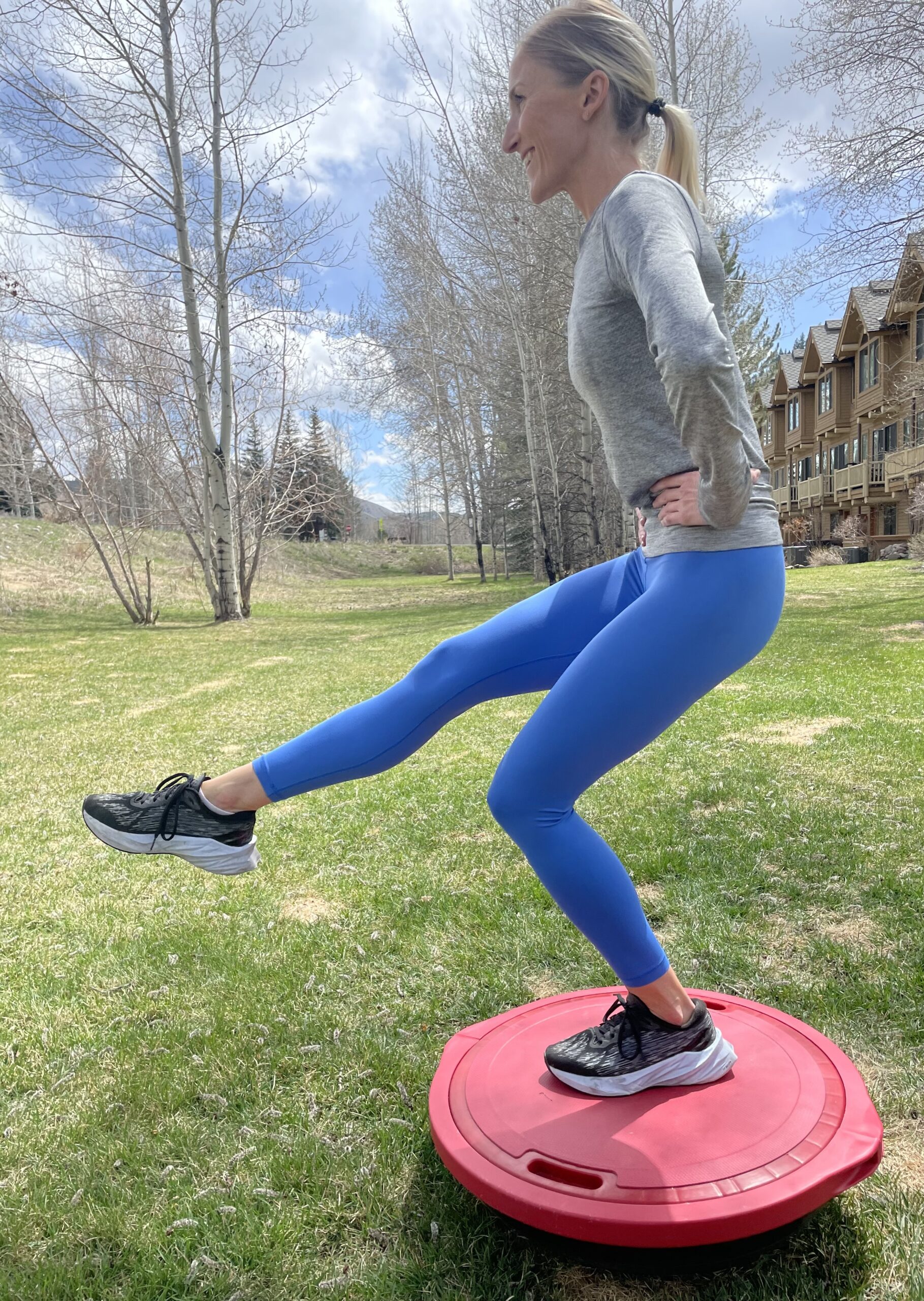
Single leg balance on an unstable surface ( BOSU )

*Tip-try to keep the flat side of the BOSU level. This means that your weight is distributed throughout your whole foot

https://www.mtexpress.com/wood_river_journal/features/can-you-stand-on-one-leg-amazingly-it-can-affect-longevity/article_e1ed9822-083b-11ef-a7f2-278d85a49540.html