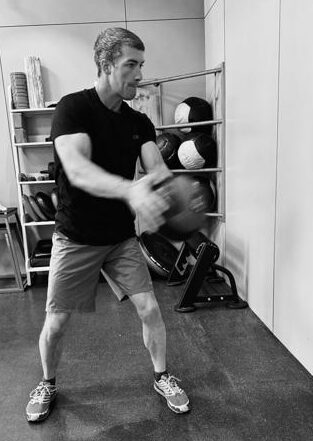
Medicine ball chop slam.
- Courtesy photo by Connie Aronson
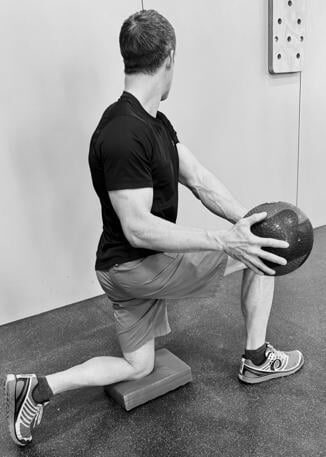
Half-kneeling medicine ball chop.
- Courtesy photo by Connie Aronson
Most sports involve some type of rotational movement. Golf, tennis, baseball, skiing and hockey all involve rotation.
Up to 84% of athletes have experienced a low back injury during their sport. In training, it is key to increase stability of the spine. Developing high levels of rotary torque is not a task for your lumbar spine and abdominal muscles; movement should be through the hip and shoulder joints. For athletic performance, learning to transfer high levels of rotary torque from the lower body to the upper body is the task of the trunk muscles.
Anti-rotational exercises can enhance your core stability and overall functional strength. In tennis, for example, the wrist, elbows, shoulder, hip, knee, ankle and toes all exhibit a rotational aspect during a simple forehand stroke. However, a limiting factor in creating more acceleration is the inability to control, or decelerate, the rotational action.
Even everyday movements, such as lifting and carrying, benefit from anti-rotational exercises, as they train the core to function as a unified system. This core stability is essential for maintaining proper posture and alignment in life and athletic endeavors.
Medicine ball chop slam
Tip: For both of the following exercises, choose a medicine ball light enough to be thrown hard but heavy enough to provide resistance. (Test a toss beforehand!)
- Stand upright with your feet parallel and spread slightly wider than shoulder width.
- Hold the medicine ball by your midsection away from the wall, with both hands.
- Tighten your glutes; brace your abdominals.
- Throughout the exercise, maintain a straight line in your body and don’t rotate your torso.
- Perform a set of slams; repeat on the opposite side.
Half-kneeling medicine ball chop
- Kneel on a foam pad or gym mat perpendicular to a wall.
- Tighten your glutes and brace your core. Throughout the exercise, maintain a straight line through your body.
- Hold the medicine ball with both hands, away from the wall, at hip height.
- Slam the ball for a set number of repetitions; repeat on the opposite side.
Connie Aronson is an ACSM exercise physiologist and corrective exercise specialist (TBBM-CES). Visit her and her golden retriever, Josie, on Instagram @conniearon.

